
Agency operating redesign
Rebuild how your agency delivers and earns.
When AI changes delivery effort, pricing and team responsibilities need another look. We help custom software and digital agencies redesign the work, the commercial model, and the decisions around both.
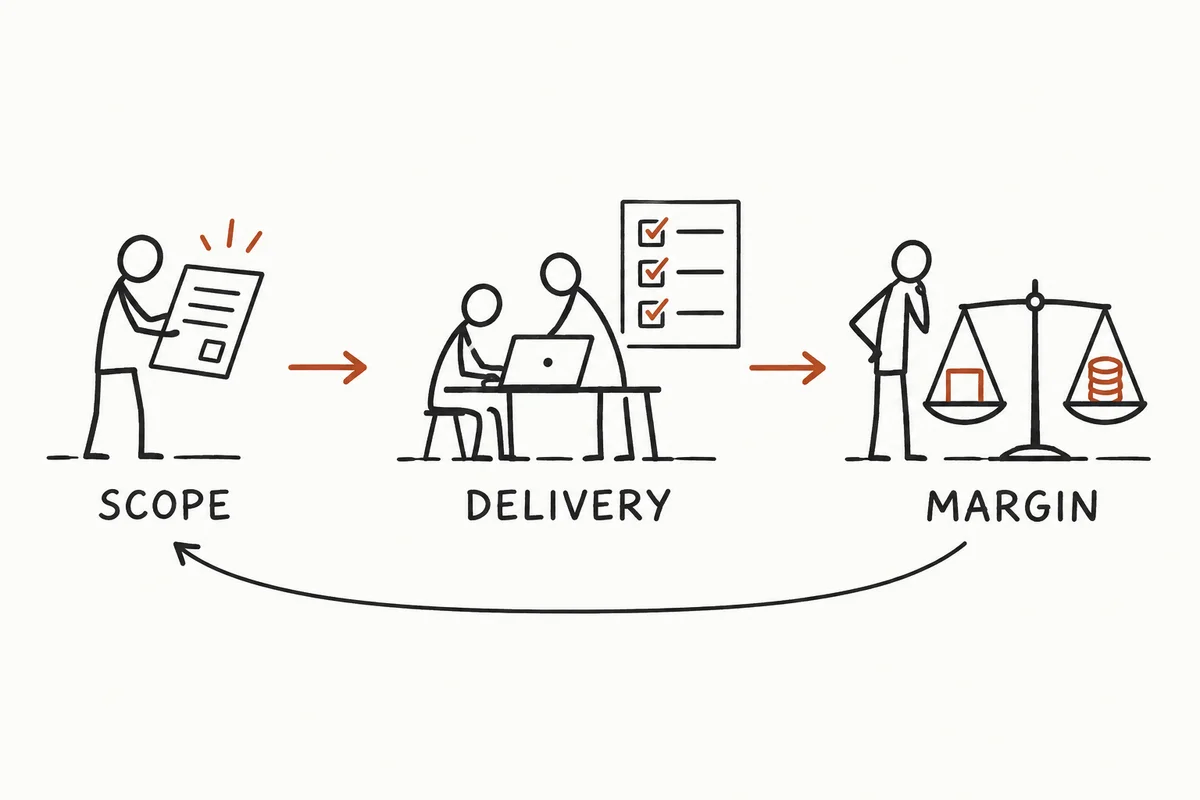
Who this is for
For founders responsible for delivery and margin.
For founder-CEOs and managing partners of custom software, product engineering, and digital delivery agencies. The intended fit is roughly 40 to 250 people and about $3M to $30M in revenue.
Start when AI-assisted work changes your estimates, clients question the price, or delivery still depends on the founder resolving every exception.
For plant and operations teams, see manufacturing operating redesign.
The expensive problem
Fewer delivery hours change the commercial equation.
An hours-based contract can turn faster delivery into lower revenue. A fixed fee can preserve revenue while leaving review effort and delivery risk poorly understood.
Faster delivery raises a commercial question: if the work takes fewer hours, what are clients paying for? It also raises an operating question: who changes estimation, quality control, and team responsibilities?
- Delivery
- AI can shorten part of the work while review, rework, and handoffs still consume the team. Look at the whole delivery flow before treating faster output as better margin.
- Commercial model
- Pricing, scope, and acceptance need to reflect how the work is actually delivered. A new tool does not resolve an old statement of work.
- Leadership
- Someone has to decide what stops, what managers own, and where human judgment remains necessary. Without those decisions, the founder remains the point of escalation.
Agency use cases
Where the operating model needs attention.
Illustrative situations for an Audit. These are not client case studies or promised results.
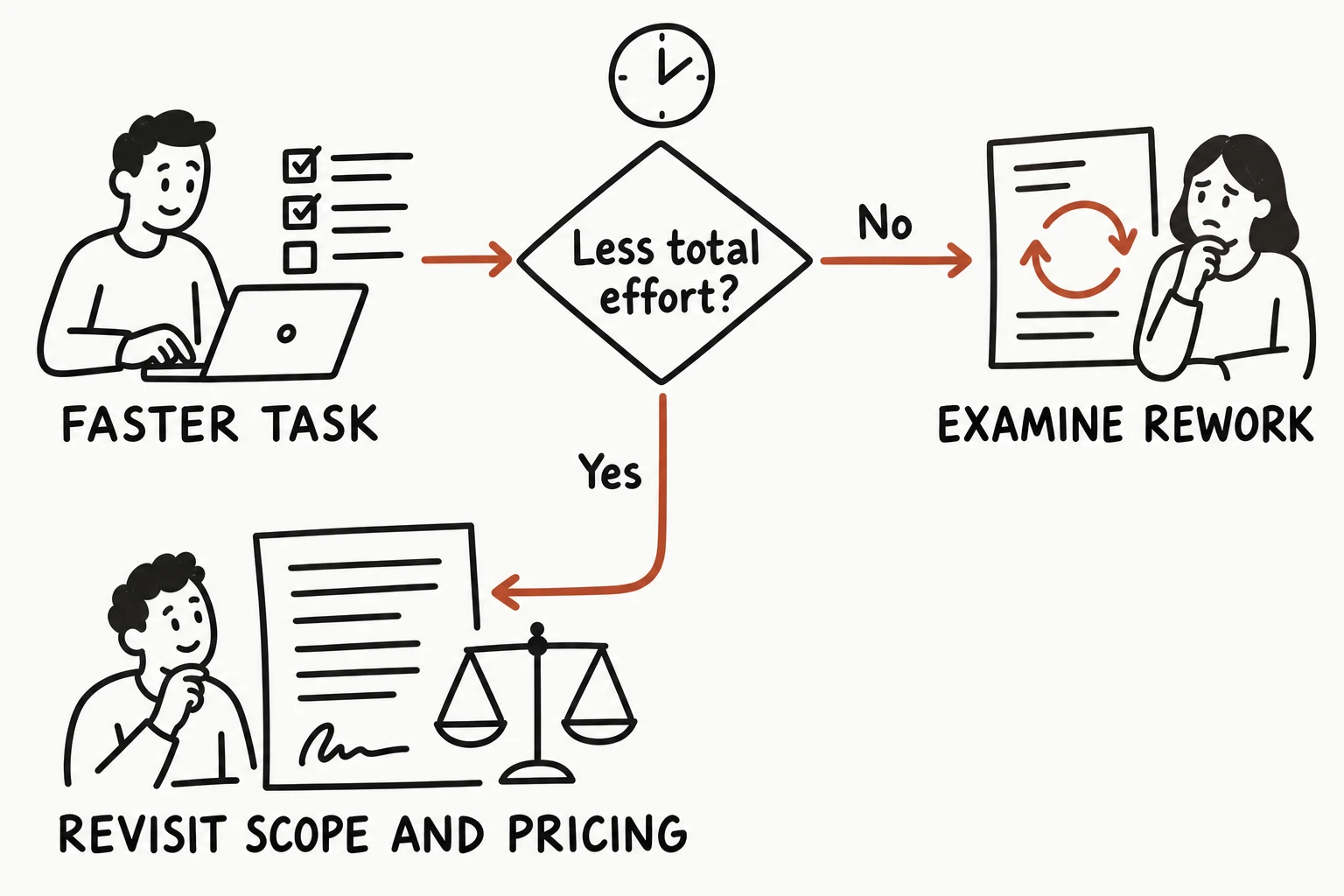
- AI-assisted delivery under an hours-based contract
- If implementation takes less time, examine what happens to revenue, review effort, and delivery responsibility. The work connects estimation, statements of work, and the commercial offer.
- A team that produces faster but still waits for decisions
- Examine handoffs, quality checks, and escalation to the founder. The rebuild question is how pods, managers, and leadership cadence should change together.
- Reusable knowledge trapped inside custom projects
- Examine which delivery assets can be reused and which depend on client context. Establish whether there is a different service offer or product opportunity before considering a newco.
How you buy
Decide at each stage how far to go.
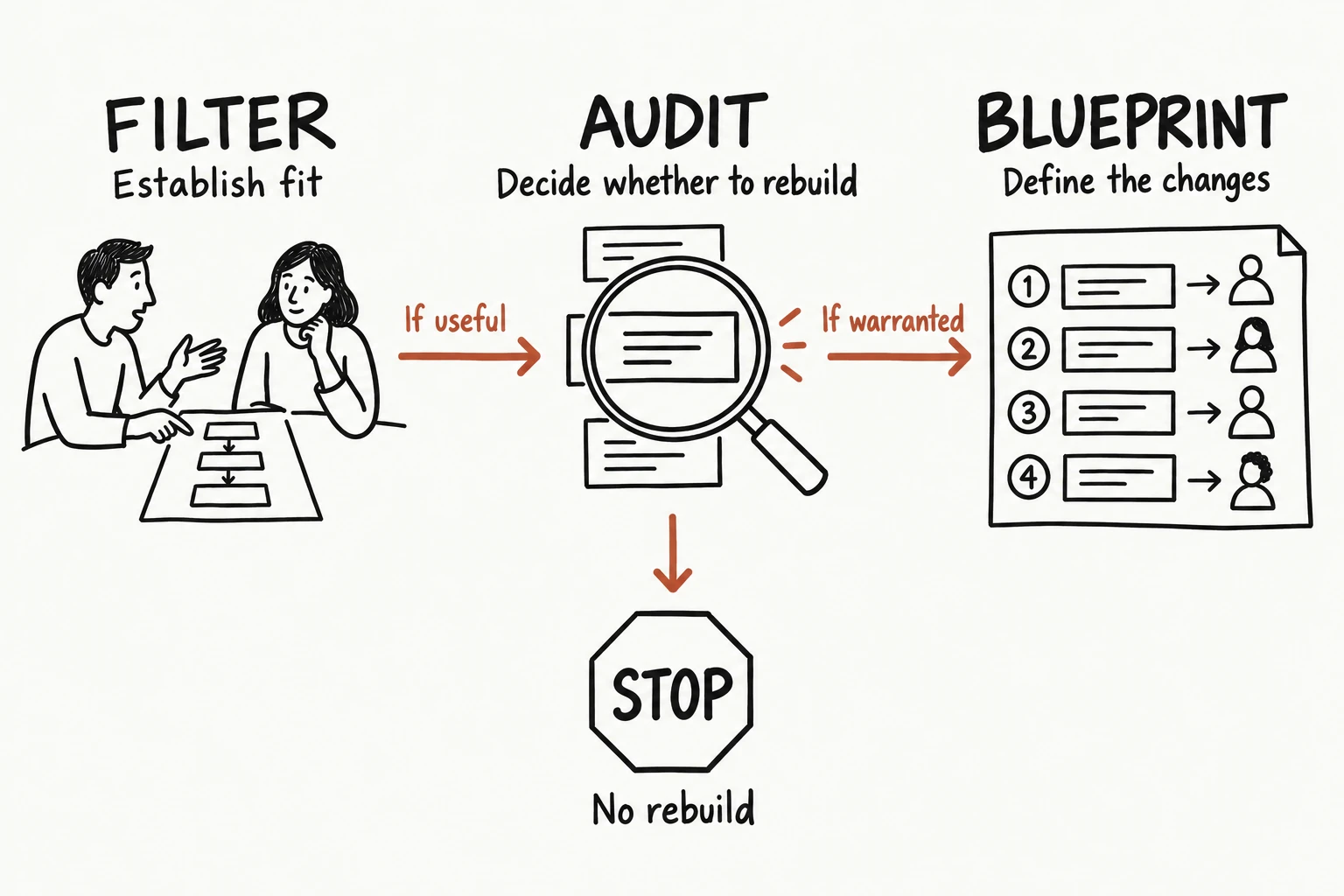
- Filter
- A free, 30-minute conversation. Bring revenue mix, headcount by function, and one difficult statement of work to establish whether an Audit fits.
- Audit
India starts from ₹1,00,000. US / Europe / UK starts from $5,000 (or €5,000 / £5,000).
For many MSMEs around ₹25 crore turnover, Audit is typically up to about ₹1,50,000.
Paid diagnosis: a focused day to map margin and operations, identify what to stop, and decide whether to rebuild.
- Blueprint
India starts from ₹4,00,000. US / Europe / UK starts from $20,000 (or €20,000 / £20,000).
A separate paid engagement over 2 to 3 weeks. Sequence delivery, commercial, and leadership changes into operating artifacts.
After Blueprint: Install puts the agreed design into daily operations. Train helps the team run it. Both are separate engagements; Train is productized.
Install: India from ₹8,00,000, scoped after Blueprint. US / Europe / UK from $40,000, scoped after Blueprint.
Filter call is free. Final fee depends on scale and complexity. Exact quote after Filter.
Optional later: if Blueprint identifies reusable intellectual property with product potential, a new company may be considered. Paid work comes first.
Capacity: a few Audits and Blueprints per quarter. Installs are rarer on purpose.
What you get in the Blueprint
A design your team can put to work.
- DiagnosisA map of delivery effort, margin, and reusable assets.
Separate work that earns its margin from work whose economics depend on selling more hours. Identify where reusable knowledge or delivery assets may support a different offer.
- Delivery redesignTeam structure, estimation, quality checks, and statements of work.
Connect team structure, estimates, quality checks, and statements of work. The delivery design has to describe how work moves and who is responsible for accepting it.
- Commercial redesignPricing, scope, acceptance, and delivery risk.
Revisit what the client buys, how the work is scoped, and where delivery risk sits. Pricing and delivery decisions need to support each other.
- Leadership changesWhat founders stop, what managers own, and where automation fits.
Make decision ownership and the leadership cadence explicit. A redesigned process needs people who can run it and make changes when it breaks down.
Install puts the agreed blueprint into daily work. Train helps the team run it.
Where we draw the line
What we refuse
The work needs a real operating problem, paid diagnosis, and someone who can make the decisions.
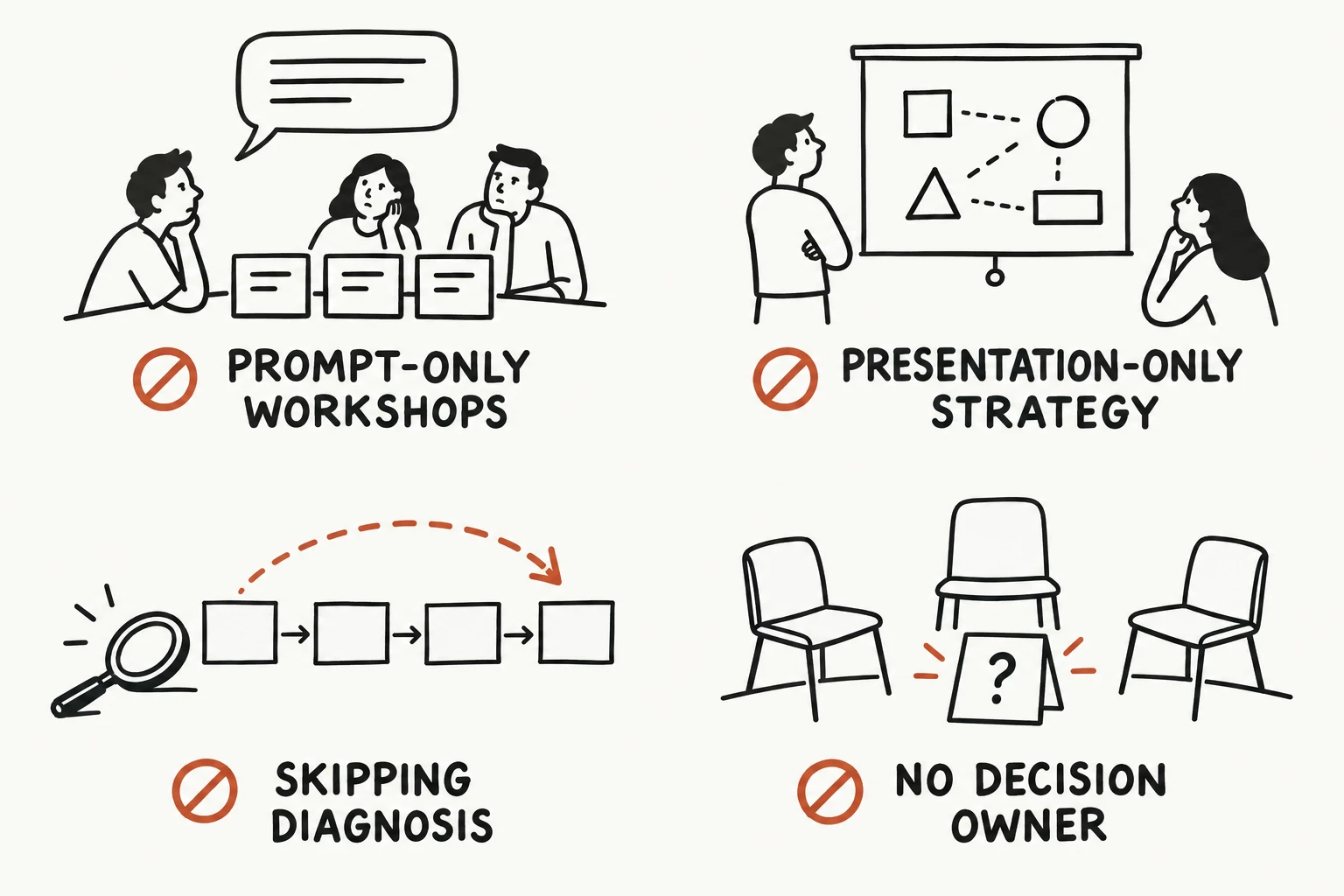
- Prompt workshops sold as transformation
- Tool instruction alone does not change how work is delivered, priced, or owned. Training follows the operating design.
- Strategy that ends with a presentation
- Blueprint must guide real work: what changes, in what sequence, and who takes responsibility.
- Quick fixes that skip diagnosis
- Audit establishes whether a rebuild is worth pursuing. We do not bypass that decision to sell implementation.
- Changes without a decision owner
- Someone inside the business needs the authority to act on the design and resolve the choices it creates.
Working together
Bring the operating problem into the room.
The filter call starts with revenue mix, headcount by function, and one statement of work that was difficult to deliver profitably. Use a real example to show where delivery effort, client expectations, and margin came apart.
Founder ownership matters because the work can change what you sell, how teams deliver it, and who makes decisions. Your leaders need to be willing to examine those choices and take responsibility for the changes.
The Audit is a decision point: whether a rebuild is worth pursuing. Blueprint turns that decision into sequenced artifacts. Install puts them into practice; Train helps your team run the resulting system.
Before the filter call
What do the engagements cost?
Filter call is free. Final fee depends on scale and complexity. Exact quote after Filter. The Filter takes 30 minutes. Audit: India starts from ₹1,00,000. US / Europe / UK starts from $5,000 (or €5,000 / £5,000). For many MSMEs around ₹25 crore turnover, Audit is typically up to about ₹1,50,000. Blueprint: India starts from ₹4,00,000. US / Europe / UK starts from $20,000 (or €20,000 / £20,000). Install: India from ₹8,00,000, scoped after Blueprint. US / Europe / UK from $40,000, scoped after Blueprint. Each stage is a separate decision. Install and Train are separate later engagements; Train is productized and priced separately.
What should we bring to the filter call?
Bring revenue mix, headcount by function, and one statement of work that was difficult to deliver profitably. The free, 30-minute conversation is about whether an Audit is a useful next step.
What is the difference between Audit and Blueprint?
Audit is a focused day to build a margin map, identify what to stop, and make a rebuild or no-rebuild decision. Blueprint takes 2 to 3 weeks and turns the diagnosis into sequenced delivery, commercial, and leadership changes.
What does Blueprint produce?
Operating artifacts covering delivery design, commercial changes, and leadership cadence. That includes work on pods, estimation, quality assurance, statements of work, and decision ownership. Install puts the Blueprint into the firm’s daily system.
Do we need Install?
If your team can drive the changes itself, Blueprint may be enough. Install is the next engagement when you need help putting that design into practice.
Will you train our team on tools?
Train comes after Blueprint/Install and focuses on running your new system. It is productized and priced separately, often using the UCS / Upsquare bench. Standalone prompt workshops are outside the offer.
Who needs to own the work inside our agency?
The founder-CEO or managing partner needs to own the decision to rebuild. Delivery, commercial, and leadership changes require the people responsible for those areas to act on the Blueprint. Operating changes without founder ownership are outside the offer.
Can equity replace the engagement fee?
No. Audit and Blueprint are paid engagements. An optional newco path comes later, only if Blueprint finds trapped product IP. Cash comes first.